by Terri Brock | HolyCoonz Maine Coon Cattery
Why some Maine Coons shimmer like silver, others reveal a hidden pale undercoat, and still others seem to change before our eyes.
Among the many beautiful Maine Coon coat colors, there is something particularly breathtaking about silver. One may have a sparkling, pale coat with delicate dark tipping. Another may appear nearly black until it turns or stretches, revealing flashes of silvery white beneath its fur. Still another has distinctive tabby markings against a cool silver background. At HolyCoonz, we see these beautiful differences firsthand in our own cats. The secret begins with a single strand of hair.
Understanding Silver Maine Coon Coat Colors?
Silver coats owe their appearance to an inherited influence called the silver inhibitor. It reduces warm yellow-red pigment (pheomelanin) and leaves the base of the hair pale, even in black smoke cats. Other inherited factors help determine how much color appears and where. In simple terms, agouti means a tabby-based coat with banded hairs; non-agouti means a solid-based coat. Silver on a solid-based cat produces smoke, while silver on a tabby-based cat can produce silver tabby, shaded or shell coats. The precise molecular workings of silver are still being studied.
Reading the Hair: Shell, Shaded, Smoke and Tabby
A useful way to picture these coats is to look at one hair at a time. CFA describes shell or chinchilla as roughly one-eighth colored at the tip, shaded as one-quarter, and smoke as one-half. These are illustrative proportions, not exact measurements or genetic tests. Some breed standards describe shaded tipping differently. Smoke is not simply a darker version of shaded: smoke is solid-based, while shaded and shell are tabby-based. Silver tabby hairs can show alternating bands of color and pale silver. Learn more: CFA coat-color identification guide.
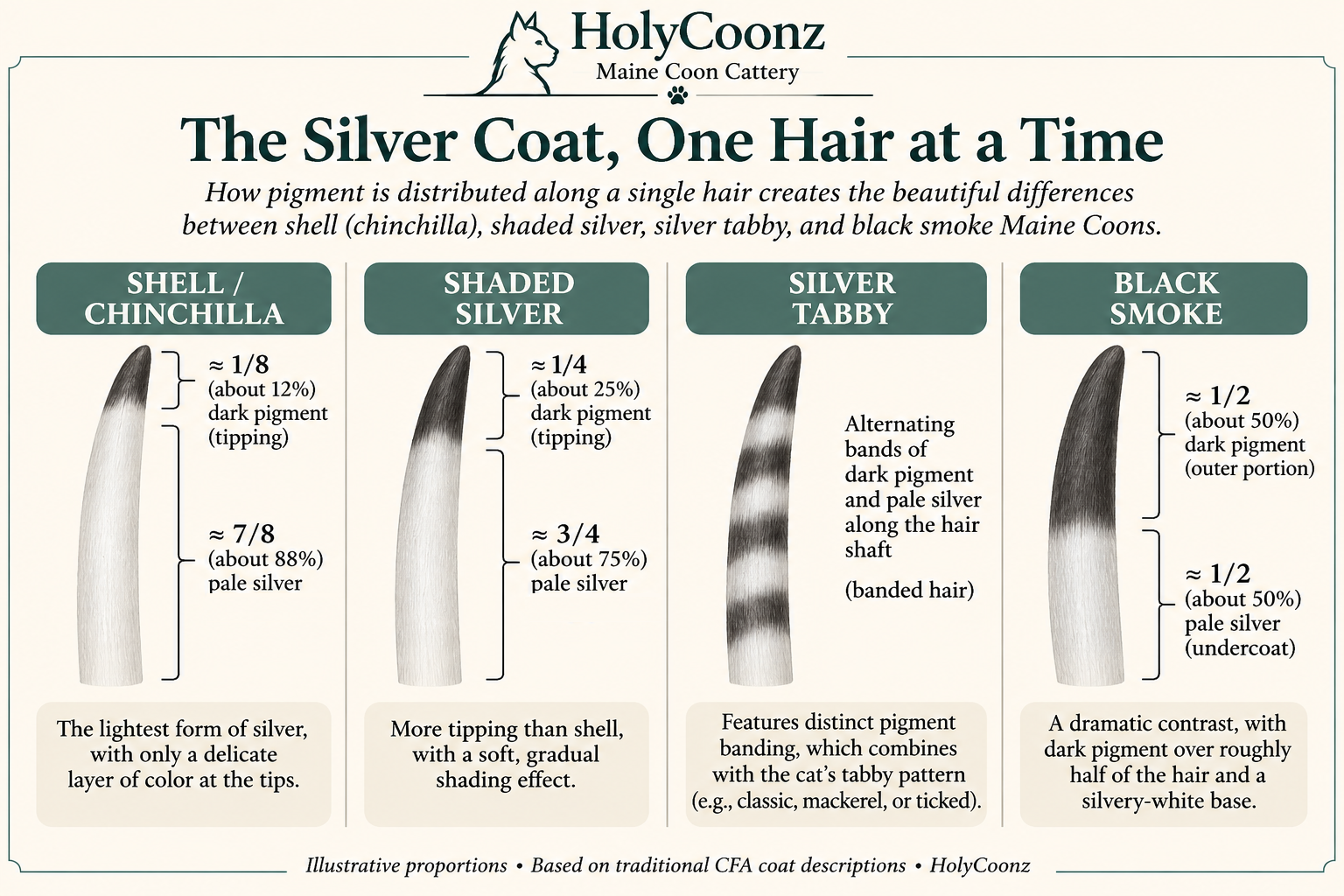
Original HolyCoonz hair-shaft comparison. Approximate CFA proportions; smoke is solid-based, while shaded and shell are tabby-based. Pale portions contain little or no pigment.
Silver Tabby: Beautiful Pattern and Contrast
A black silver tabby combines a pale silver background with dark markings. Classic tabbies show broad swirls; mackerel tabbies show narrower stripes; and ticked tabbies display banded hairs with less obvious striping over much of the body. Our HolyCoonz Guinevere Willow is a black silver ticked tabby (MCO ns 25). Her coat is a wonderful reminder that silver tabbies do not all have dramatic side swirls.
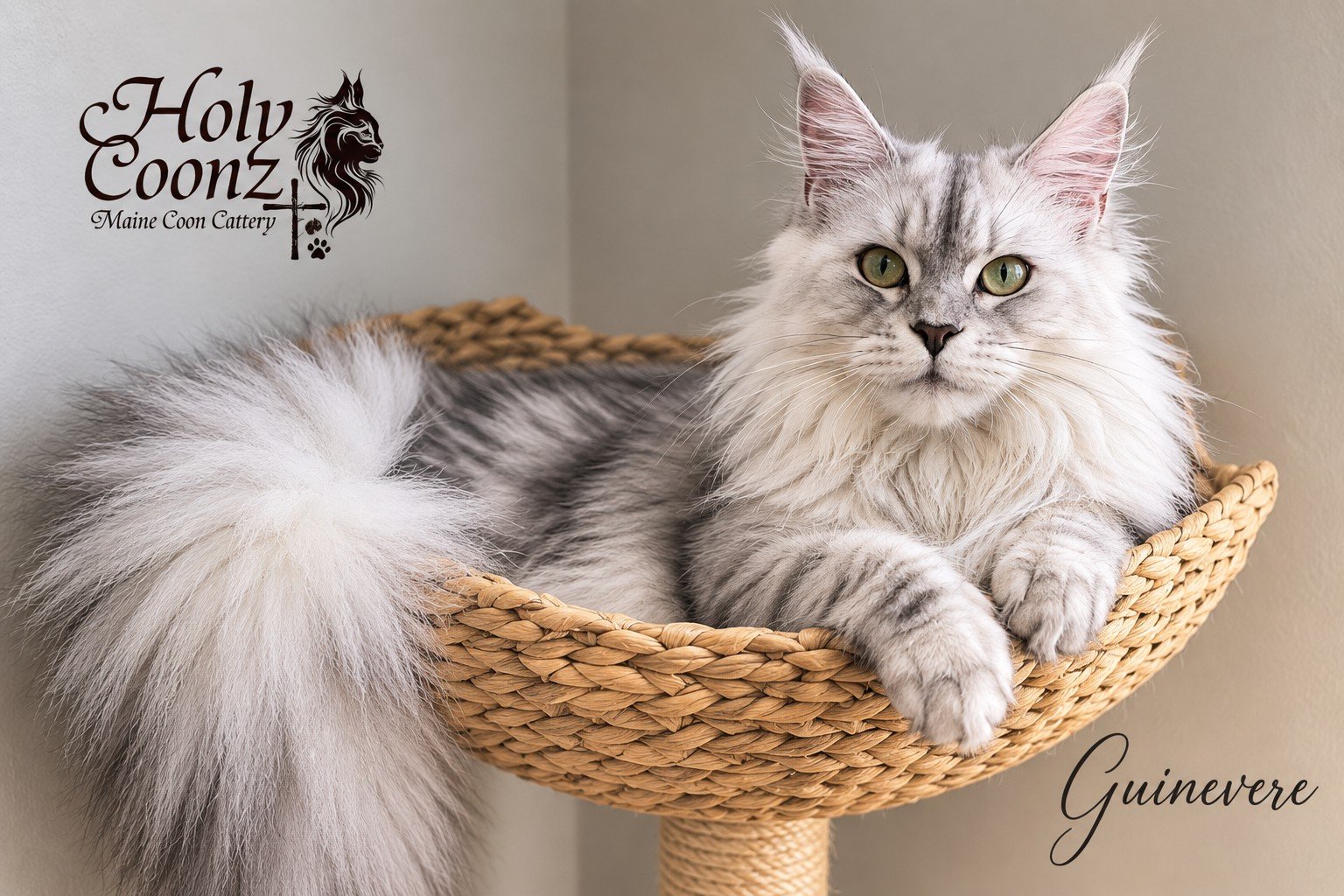
HolyCoonz Guinevere Willow (“Guinevere”) — Black Silver Ticked Tabby Maine Coon (MCO ns 25). — Meet our cats
Black Smoke: A Hidden Silver Surprise
A black smoke Maine Coon may look almost entirely black when resting. When the coat moves or separates, its silvery-white base becomes visible beneath the darker outer hair. This is not simply a black coat with scattered white hairs; the pale base is part of the pigment pattern. Hannah (Nevitha-Luxury Coons Rusalka) and Toby (Fighter of Magic Art) are both black smoke Maine Coons (MCO ns), each with an individual expression of the pattern. A smoke is a solid-based (non-agouti) cat with silver.
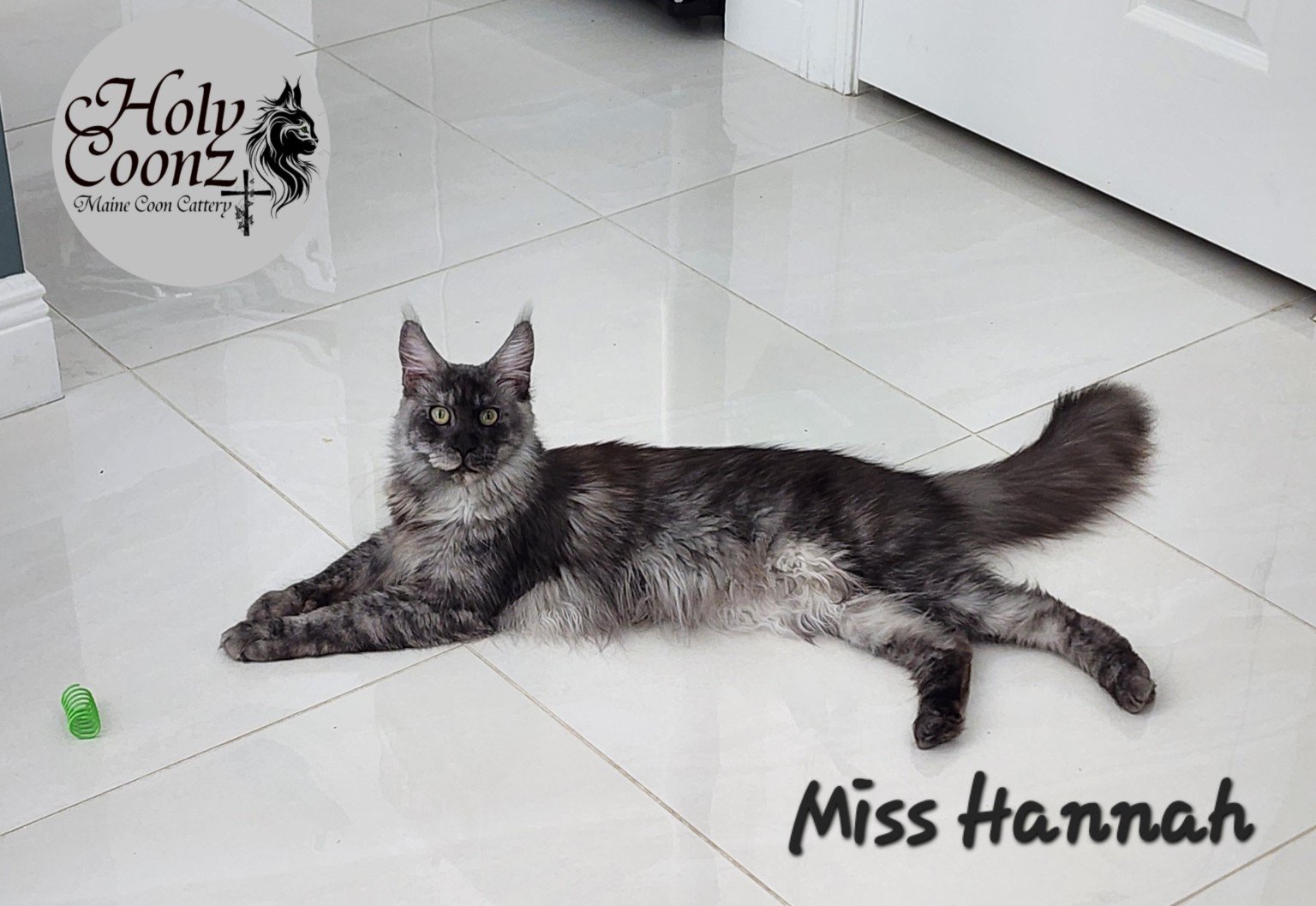
Nevitha-Luxury Coons Rusalka (“Hannah”) — Black Smoke Maine Coon (MCO ns). — Meet our cats
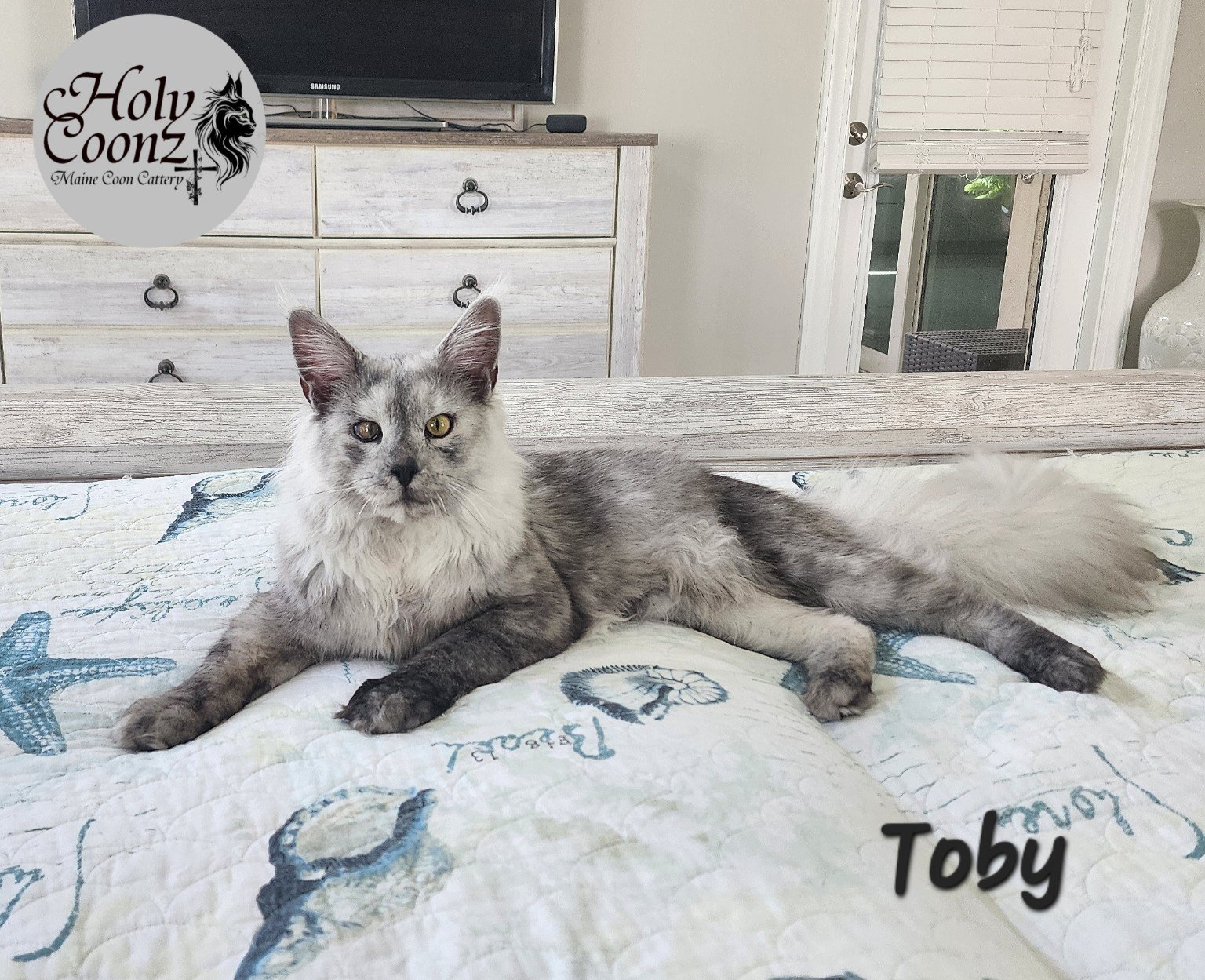
Fighter of Magic Art (“Toby”) — Black Smoke Maine Coon (MCO ns). — Meet our cats
Shaded Silver: A Soft, Luminous Mantle
In shaded silver coats, the dark pigment is concentrated nearer the hair tips than in smoke coats, allowing more pale undercoat to show. The result is a lighter, softly shaded appearance, often with a darker mantle across the back and head. Black Knight of Magic Art (“Knight”) is our black silver shaded Maine Coon (MCO ns 11). His beautiful tipping can look dramatically different depending on the light.
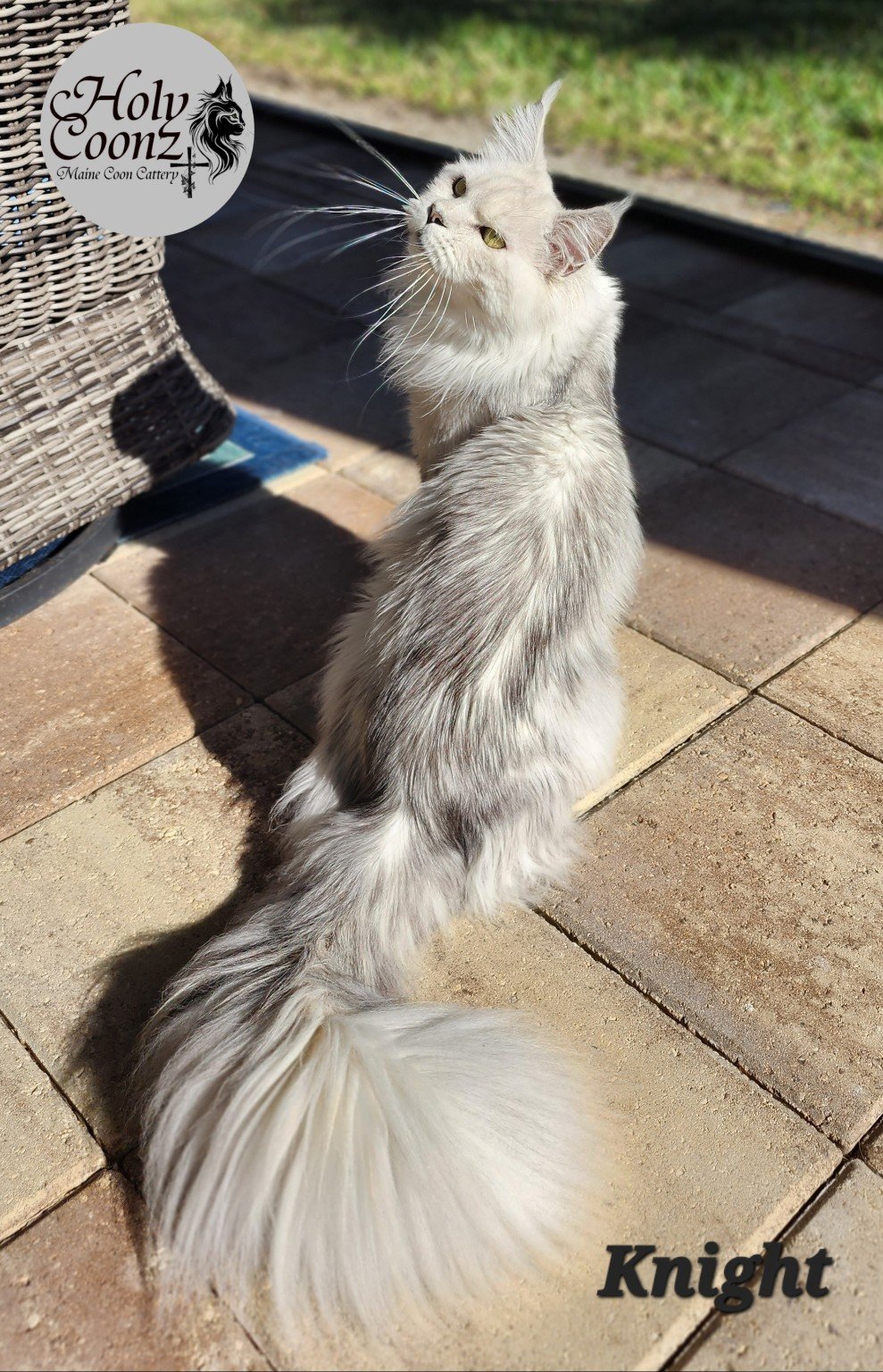
Black Knight of Magic Art (“Knight”) — Black Silver Shaded Maine Coon (MCO ns 11). — Meet Knight
Chinchilla or Shell: The Lightest Tipping
Shell, often called chinchilla, has less colored tipping than shaded silver, creating an exceptionally pale, sparkling effect. Our Eclipse of Magic Art is registered with TICA as a Blue Silver Chinchilla Torbie (EMS equivalent MCO gs 12). Her blue and cream coloring is especially delicate. Comparing Eclipse and Knight helps families see how a shell coat differs from a shaded one.
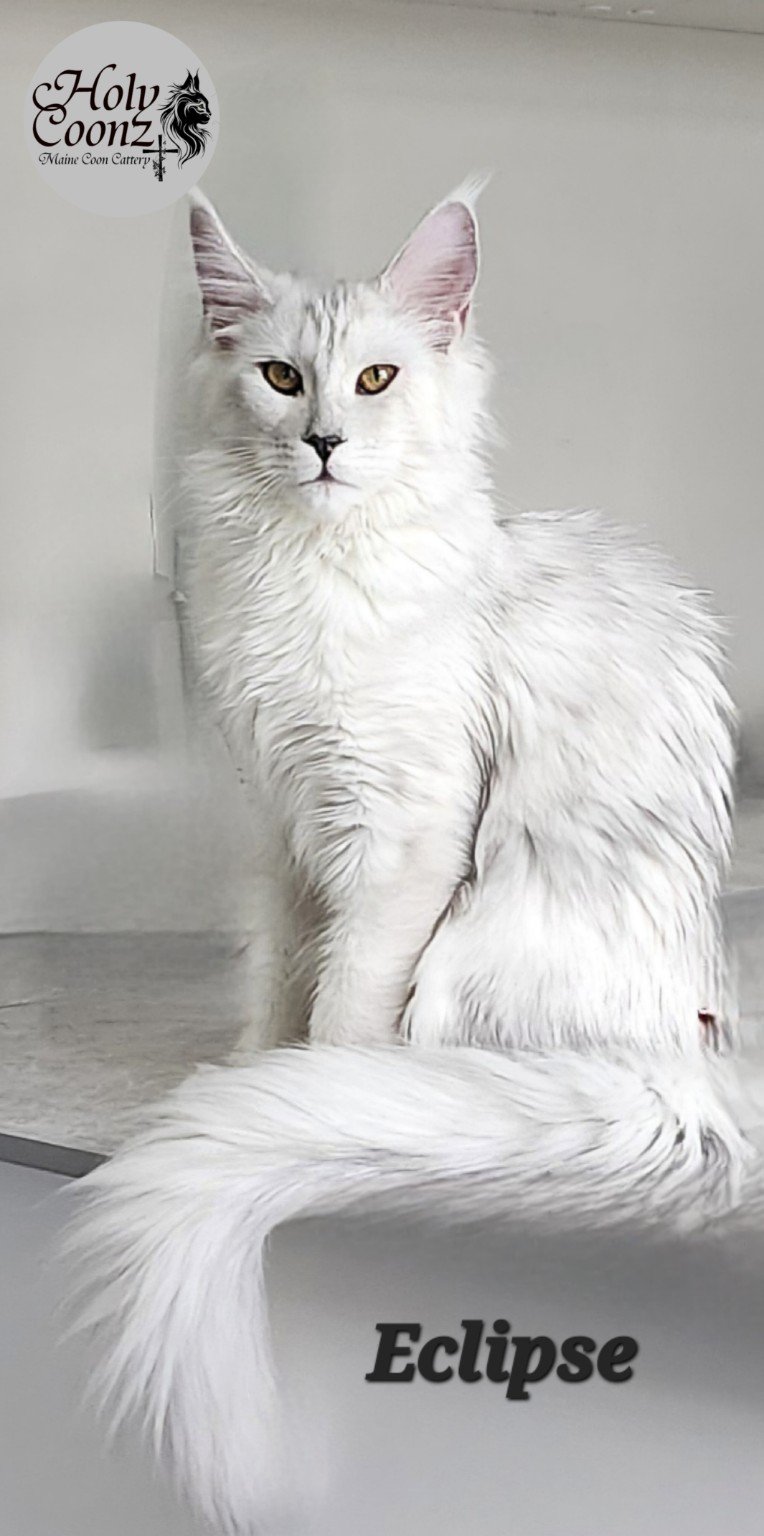
Eclipse of Magic Art (“Eclipse”) — Blue Silver Chinchilla Torbie Maine Coon (MCO gs 12). — Meet our cats
A New Tool: DNA Testing for the Silver Inhibitor
A newer DNA test for the silver-associated variant became available around the turn of 2024. The University of Missouri explains that silver is inherited dominantly: one copy of the variant can produce silver. Testing can help breeders tell whether a cat has one or two copies, something appearance alone cannot establish. The affected gene and precise mechanism are still being investigated. The test does not predict whether a cat will look smoke, shaded, shell or tabby.
Our cats’ established silver and smoke coat descriptions do not require a new DNA test to prove what they visibly are. This test is an additional tool for understanding inheritance—not a substitute for experienced coat assessment, and not a health-screening test.
For more information: University of Missouri silver genetic testing FAQ • TICA silver testing announcement
Why Kittens Can Look Different as They Grow
A young kitten’s coat is not always a reliable preview of its mature appearance. Smoke undercoats may become easier to see as the coat develops; shaded kittens can show more noticeable juvenile markings; and a growing Maine Coon’s longer fur changes how light, tipping and contrast appear. The inherited color is not simply changing into a different genetic color—the visible expression is developing. That transformation is one of the joys we share with HolyCoonz families. Understanding how Maine Coon coat colors develop helps families appreciate the beautiful changes they may see as their kitten matures.
Why Lighting and Photographs Matter
Bright natural light can emphasize silver undercoat and pale tipping, while indoor shadows may make a smoke cat appear nearly black. Camera exposure and viewing angle also affect the result. A single photograph may not capture the full beauty of a coat, so we prefer multiple honest photographs rather than relying on one dramatic image.
Do These Colors Need Different Grooming?
Not simply because of their pigment. What matters most is the Maine Coon’s coat length, texture and individual grooming needs. Gentle, regular combing helps prevent tangles behind the ears, under the front legs and around the hindquarters. For our grooming routine and favorite tools, see The Complete Maine Coon Grooming Guide
Beauty Is Only Part of the Story
Color alone does not predict a Maine Coon’s temperament, health or quality as a companion. At HolyCoonz, our priorities are health, temperament, sound structure and thoughtful early socialization. Our breeding parents undergo relevant DNA health screening, cardiologist-performed echocardiograms and hip evaluations; these are distinct from the veterinary examinations, vaccinations and care individual kittens receive. Learn more in our article on Maine Coon Health Testing
Frequently Asked Questions
Is black smoke the same as silver tabby?
No. A black smoke is solid-based with a pale hair base revealed when the fur separates. A black silver tabby is tabby-based, with classic, mackerel, spotted or ticked patterning against a silver background.
What is the difference between shaded and shell?
Both have pale bases and dark tips, but shell/chinchilla has less dark tipping and usually looks lighter overall.
Can a smoke Maine Coon look solid black?
Yes. The pale undercoat may be hard to see until the cat moves or the fur is parted.
Does a silver kitten keep the same appearance as an adult?
Not necessarily. The underlying inherited color remains, but tipping, coat length and contrast can look quite different as the kitten matures.
Does silver color determine personality?
No. Personality is individual and influenced by multiple factors, including inherited temperament and early experiences.
What is the difference between a tortie and a torbie?
A tortie combines black and red, or their lighter versions, blue and cream. A torbie is a tortoiseshell cat with a tabby-based pattern. Eclipse is our example of a blue silver chinchilla torbie. Shaded and shell coats are tabby-based, which is why a chinchilla like Eclipse is a torbie.
What do the letters and numbers after each cat’s name mean?
EMS stands for Easy Mind System, used by registries including FIFe and WCF. MCO means Maine Coon, n means black, g means blue tortoiseshell, and s means silver. The numbers 11, 12 and 25 identify shaded, shell and ticked respectively. With no pattern number, ns means black smoke. Our cats are TICA-registered; these codes are EMS equivalents, not TICA registration codes. See the WCF official EMS code list and CFA coat and color descriptions.
A Little Silver, a Lot of Love
The remarkable diversity of Maine Coon coat colors is one of the many things that makes this breed so captivating. Whether it is Hannah and Toby’s dramatic black smoke coats, Knight’s silver shading, Guinevere’s beautiful ticked tabby pattern, or Eclipse’s delicate chinchilla torbie coat, each of our Maine Coons reminds us how wonderfully varied this breed can be. Their coats catch the eye, but their companionship captures the heart.
Purposefully Bred. Properly Raised. Lifetime Supported. — Guided by faith. Grounded in the Word.
“Every good and perfect gift is from above.” — James 1:17 (NIV)
More questions? Visit our FAQ: HolyCoonz FAQ